
Music production is the technical and creative process that turns an idea into a song ready for release on digital platforms.
Many people associate production only with recording, but the complete process includes several defined stages, each with a specific role in final quality.
Understanding all stages helps optimize resources, improve outcomes, and avoid cumulative errors that are difficult to fix later.
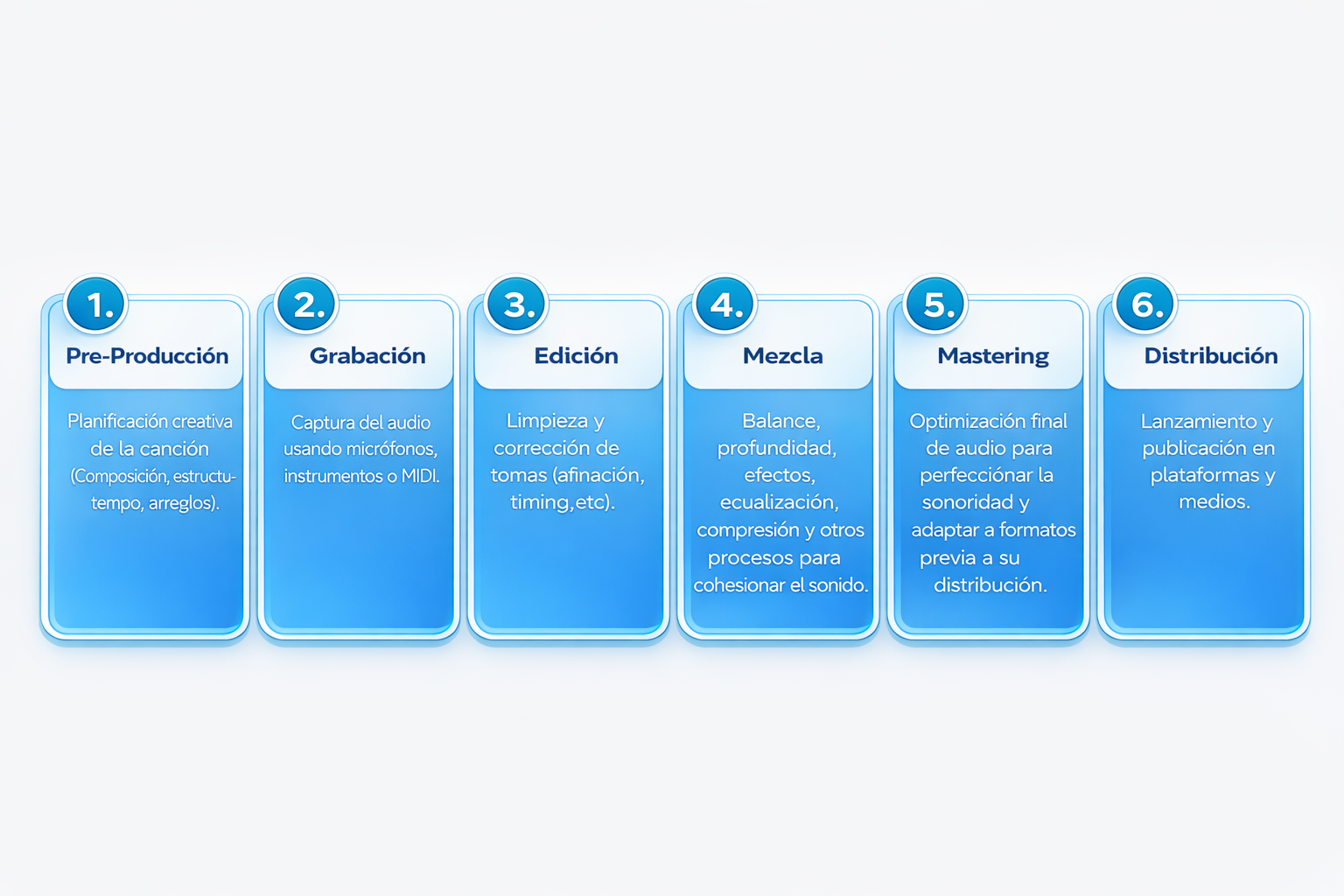
Below is the full professional workflow.
1. Pre-production
Pre-production is planning and creative development.
This is where you define:
- Song structure (intro, verse, chorus, bridge)
- Tempo and meter
- Key/tonality
- Instrumentation
- Arrangement direction
- Sonic references
- General aesthetic target
Strategic decisions made here affect everything that follows. Strong pre-production reduces rework and improves recording efficiency.
It is also the ideal stage to detect structural song issues before committing to full tracking.
2. Recording
Recording captures performances in digital form.
Typical sources include:
- Lead and backing vocals
- Acoustic instruments
- Electric instruments
- MIDI programming
- Synth layers
- Electronic/percussion elements
Critical factors:
- Microphone selection and quality
- Room acoustics
- Recording technique
- Performance quality
- Proper gain staging
Technically clean recording makes later editing, mixing, and mastering significantly easier.
3. Audio editing
Editing is focused on cleaning, correcting, and optimizing takes before mixing.
Typical tasks:
- Comping (best-part selection from multiple takes)
- Timing correction
- Rhythmic alignment
- Transient refinement
- Vocal pitch correction when needed
- Noise/click cleanup
- Session organization
The objective is not removing identity, but increasing precision and consistency.
4. Mixing
Mixing integrates all tracks into one coherent listening experience.
Level balance
Set relative levels so each element is present without unnecessary competition.
Equalization
Organize frequency content to reduce buildup and improve definition.
Compression and dynamics
Control dynamic behavior for cohesion while preserving musical movement.
Stereo image
Define spatial placement through panning and stereo processing.
Effects processing
Use reverb, delay, and related tools to create depth and context.
Automation
Allow the mix to evolve section by section.
Mixing can completely change song perception by defining clarity, depth, energy, and character.
5. Professional mastering
Mastering is the final optimization stage before release.
Main objectives:
- Refine global tonal balance
- Control overall dynamics
- Optimize perceived loudness
- Ensure consistency across tracks (EP/album)
- Improve translation across playback systems
- Prepare files for platform standards
Mastering also includes technical QC such as artifact checks, fade verification, format preparation, and dithering where required.
6. Distribution
Distribution is when the project reaches listeners.
Typical platforms:
- Spotify
- Apple Music
- YouTube
- Amazon Music
- Deezer
This stage includes format delivery, metadata, credits, ISRC codes, and platform-ready master versions.
Good technical preparation in previous stages reduces rejection and normalization issues at release.
Why each stage matters
Each phase has a specific role:
- Pre-production defines direction
- Recording captures performance quality
- Editing removes technical friction
- Mixing builds sonic coherence
- Mastering ensures release readiness
- Distribution connects music with audience
Skipping or underestimating stages creates limitations that are difficult to solve later.
Music production at Budokan Studio
At Budokan Studio we focus specifically on final stages:
- Audio editing
- Professional mixing
- Mastering for digital release
We receive recorded material and optimize it technically and musically for clear, coherent, release-ready outcomes.
Our method combines technical analysis, critical listening, and current industry standards.
Conclusion
Music production is a structured process that goes far beyond recording a song.
Each stage adds specific value and contributes directly to professional final quality.
Understanding this full workflow helps artists and producers plan better and unlock more potential in every release.
Benjamín Gual, productor, ingeniero de mezcla y mastering