
Acoustics is one of the most decisive factors in recording and mixing quality. Yet in home studios, it is often the most neglected one.
It is common to invest in monitors, interfaces, and plugins first. But if your room distorts what you hear, your technical decisions are built on unreliable information.
Accurate mixes begin with accurate listening, and that depends heavily on treatment.
In this guide we cover what problems you must solve first, what treatment makes sense to buy, and how to place it properly in a home studio.
1. What happens in an untreated room
In typical small rooms (bedroom, office, compact studio), you do not hear only direct monitor sound. You also hear:
- Side-wall reflections
- Ceiling reflections
- Desk reflections
- Bass accumulation in corners
- Interference between direct and reflected sound
This generates:
- Frequency boosts and cancellations
- Tonal imbalance
- Unstable stereo image
- Incorrect low-end decisions
Result: a mix that sounds "fine" in your room but translates poorly on other systems.
2. Priority acoustic issues in home studios
In small rooms, three priorities should be addressed first:
A) Early reflections
Reflections arriving milliseconds after direct sound reduce clarity and blur stereo localization.
B) Low-frequency accumulation
Corners reinforce bass and create room modes that severely alter what you hear in the low end.
Low-end management is usually the hardest challenge in small studios because room dimensions amplify modal behavior.
C) Unbalanced absorption
Overusing thin foam often absorbs highs while leaving low-mid and bass issues mostly unresolved.
Effective treatment must address all three points in balance.
3. What acoustic treatment should you buy
Not every product sold as an "acoustic panel" is useful for reliable monitoring.
Thin foam panels (3-5 cm)
These are common and inexpensive, but:
- They mainly absorb high frequencies
- They do not properly control bass
- They do not solve structural room problems
Traditional open-cell foam can create the illusion of control while low-frequency energy keeps building up and causing phase/translation issues.
Foam can be a complement, but it should not be your core strategy.
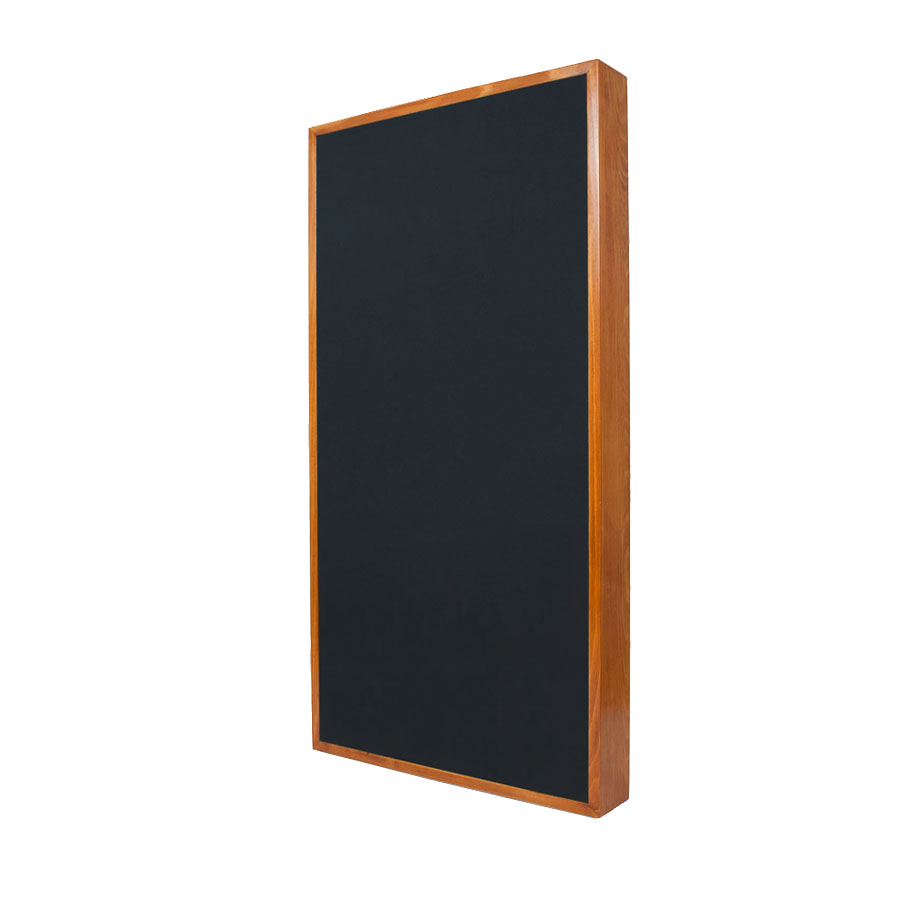
Mineral wool or fiberglass broadband panels
This is the professional baseline and usually the best ratio of cost vs real acoustic improvement.
Recommended specs:
- Minimum thickness: 10 cm
- Typical density: 40-60 kg/m3
- Rigid frame
- Breathable fabric (non-plastic)
For stronger low-end performance, higher densities can be considered depending on design goals.
4. Bass treatment
Bass treatment deserves dedicated focus because low-frequency wavelengths are long and strongly interact with small rooms.
For example:
- 50 Hz ~= 6.8 m
- 80 Hz ~= 4.3 m
- 100 Hz ~= 3.4 m
These interactions create modes that reinforce some notes and cancel others. This is a room physics issue, not something EQ alone can fully solve.
4.1 Corner bass traps (porous/mineral fiber)
Standard solution: broadband traps with enough thickness, placed strategically.
Placement strategy
Prioritize:
- Vertical corners (wall-wall)
- Wall-ceiling boundaries
- As much floor-to-ceiling coverage as possible
Corners are high modal-pressure zones, so treatment there gives more impact than random flat-wall placement.
Air gap
Leaving an air gap behind porous panels can improve low-frequency efficiency, especially in the low-mid range.
4.2 Limp-mass traps
For severe sub-100 Hz resonances, limp-mass concepts can complement porous treatment in specific setups.
These rely on flexible heavy layers to damp low-frequency motion more effectively in targeted areas.
4.3 Practical low-end principle
Unlike high-frequency treatment (where over-absorption can become a problem), dedicated bass control usually improves as corner coverage increases.
The goal is not removing bass from music, but stabilizing room response so bass is represented more truthfully.
4.4 Real-world alternatives
If full treatment is not possible, practical alternatives can still help reduce severe reflections:
- Heavy layered fabrics with spacing
- Bookshelves for partial diffusion in mids/highs
- High-quality headphones as low-end cross-check support
These are not perfect replacements, but they can improve decision reliability when space/budget is limited.
5. Minimum recommended setup for a small room
For roughly 9-12 m2 rooms, a functional baseline is:
- 4 broadband panels (10 cm) for first-reflection points
- 1 extra panel on rear wall if possible
- Bass traps in at least two front corners
This setup already produces significant improvements in clarity, balance, and translation.
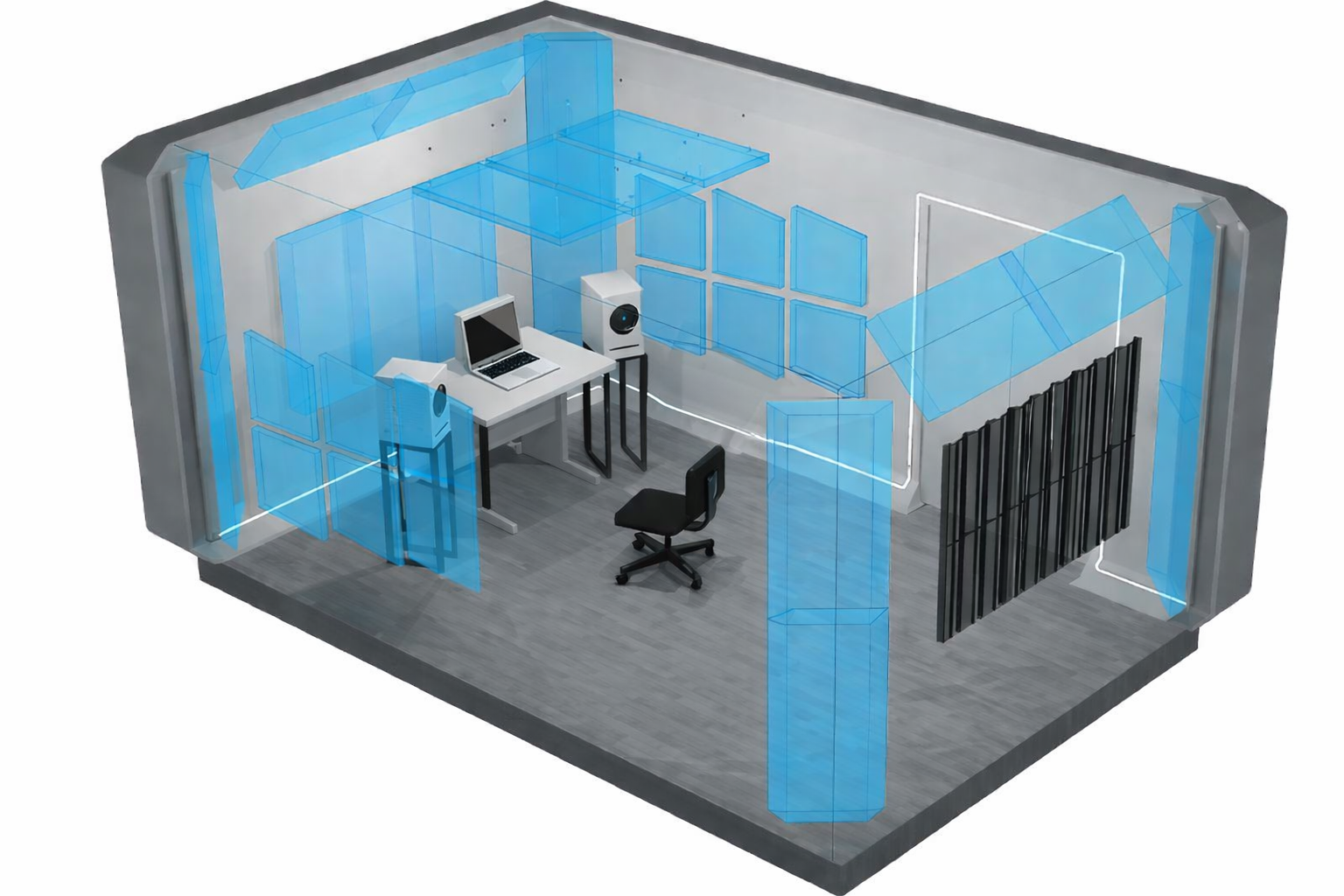
6. Where to install panels
First-reflection points
Usually:
- Left wall
- Right wall
- Ceiling above listening position
- Rear wall if close to listening point
Corners
Bass traps should prioritize:
- Front corners
- Rear corners when possible
- Wall-ceiling boundaries where feasible
More corner coverage usually means more stable low-end behavior.
Reference example:
7. Panel distance from wall
If space allows, leaving 5-10 cm behind a panel can improve lower-frequency absorption.
For bass trapping, greater spacing can further improve low-end efficiency.
8. Prefabricated panels vs DIY
Prefabricated
- Cleaner visual finish
- Faster installation
- Higher cost
DIY
- Lower cost
- Full control over materials
- Comparable performance if built correctly
Both options can work if thickness and density are selected correctly.
9. What to avoid
- Covering everything with thin foam
- Ignoring corners
- Random panel placement without acoustic logic
- Assuming more foam always means better acoustics
- Mixing too loud to compensate room problems
- Using a subwoofer in untreated small rooms
Good acoustics is about strategic control, not random material coverage.
10. Real impact of proper treatment
A treated room gives:
- Cleaner and more readable low end
- Better source separation
- More stable stereo image
- Lower listening fatigue
- More consistent decisions
- Better translation on other systems
Even moderate treatment can dramatically improve a home studio. Professional consistency always depends on listening environment control.
Conclusion
Acoustics is not optional decoration. It is a core part of your monitoring system.
Treating a room does not always require building from scratch, but it does require:
- Understanding which problem you are solving
- Choosing the right treatment type
- Installing it in the right positions
Reliable listening leads to reliable mixes, and reliable listening starts with the room.
Benjamín Gual, productor, ingeniero de mezcla y mastering